Research
Cranium CoRE and K-12 ELA standards
Educators familiar with Cranium CoRE who experience it with students see the seamless connection between Cranium CoRE and the Common Core Standards for English Language Arts.
Research
Educators familiar with Cranium CoRE who experience it with students see the seamless connection between Cranium CoRE and the Common Core Standards for English Language Arts.
Here is a recent quote from Tykisha Grant at Northboro Elementary School (Palm Beach County):
"My students and I really enjoyed having the opportunity to use Cranium CoRE with one of the SSYRA titles. My students were excited and eager to interact with the text and each other while playing the Cranium CoRE game! In the district, teachers must make sure their classrooms demonstrate the "core actions" which include students interacting meaningfully with high quality text, and being engaged in discussions that draw from the text in an engaging format. The Core Actions require that a significant amount of instructional time be focused on students reading, discussing complex text and responding in depth to text dependent questions. Cranium CoRE does all of those things. In fact, Cranium CoRE brings gamification to "the Core Actions" in ELA literacy instruction."
Educators familiar with Cranium CoRE who experience it with students see the seamless connection between Cranium CoRE and the Common Core Standards for English Language Arts. To be specific, they see how Cranium CoRE methods for reading, writing, speaking and listening skill development balance the need for more stringent complexity and a student's sense of fun, i.e. authentic engagement with the learning process.
Unique to the implementation of Cranium CoRE is the collaborative nature at many levels; students within the classroom as teammates for both game play and complex textual question composition, teacher to teacher, librarian to teacher, school to school for game play, even on a global scale, as well as mentoring student to student across grade levels.
The grade level specific document here shows how Cranium CoRE aligns with and supports both the Common Core English Language Arts Standards as well as the AASL Standards for the 21st-Century Learner.
As you plan to implement Cranium CoRE to assist you as an educator meet these standards to better prepare our students to be life-long learners, please keep in mind these three major points:

The following document is a good summary tool for teachers and administrators. We took the opportunity to highlight sections where Cranium CoRE can help support your implementation efforts. We welcome the chance to discuss or, even better, model, how Cranium CoRE will assist your CCSS ELA implementation within any classroom, regardless of the curriculum.
Literacy Implementation Guidance for the ELA Common Core State Standards - Written by the International Reading Association.
The Common Core State Standards for English Language Arts are built on a short set of College and Career Readiness anchor standards. The grade-specific standards for grades 3 through 12 "correspond to the College and Career Readiness (CCR) anchor standards below by number," adding grade-level specificity to the same core skill. That is why one Cranium CoRE game design works from third grade to twelfth: the question writer raises the complexity, and the anchor skill stays put. The wording in quotes is the standard itself.
The Common Core State Standards are still published, still maintained and still the ELA standards (or the base of them) in much of the country. Nearly every state adopted them around 2010. In the years since, a number of states have renamed, revised or formally replaced them, usually keeping the same architecture: read closely, cite evidence, determine central ideas, discuss collaboratively, write arguments from texts.
Florida is a good example of how little the classroom skill changes when the label does. Florida replaced the Common Core with its B.E.S.T. Standards (Benchmarks for Excellent Student Thinking) in 2020. The very first K-12 expectation in the B.E.S.T. ELA standards, ELA.K12.EE.1.1, is "Cite evidence to explain and justify reasoning." That is discuss and defend, written into state policy. Cranium CoRE's Florida alignment document is linked on this page under K-12 ELA Standards.
If your state uses its own standards, the grade-level alignment documents above still work as a map. Find the anchor skill, then find the matching benchmark in your document. Every state asks students to support answers with evidence from the text. Cranium CoRE does not care what the standard is called. It cares that a team can point to the line and say why.
The anchor standards do not change between third grade and twelfth. The grade-specific standards add precision: a third grader refers to the text when asking and answering questions, an eighth grader cites the evidence that most strongly supports an analysis, a senior weighs where the text leaves matters uncertain. In Cranium CoRE that progression is the question writer's job, and the format never has to change.
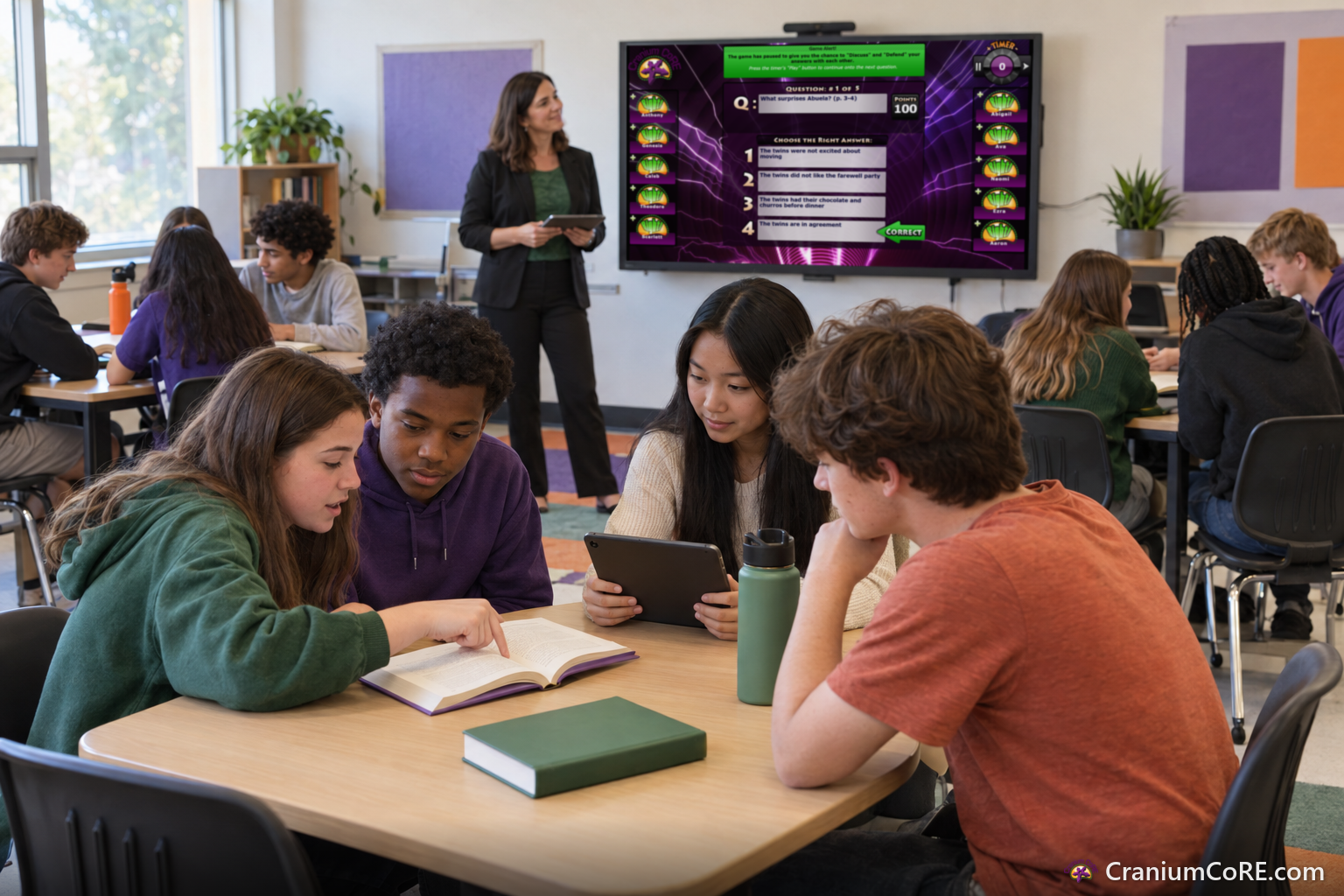
A grade 3 game on a Sunshine State Young Readers Award title asks a team for the line that shows how a character feels. A grade 7 game asks which of four passages best supports a claim about the theme. A grade 11 game asks which passage best reveals the author's purpose in a chapter, and the defend step turns into a seminar. Same screen at the front, same team, same one device, same open book.
That is also why Battle of the Books districts run Cranium CoRE in three bands, grades 3-5, 6-8 and 9-12, with the same software and the same host rules. And it is why the writing step works as mentoring: an eighth-grade team writing a game for fifth graders has to think about what a fifth grader can find in the text.