Cranium CoRE Research

The research behind Cranium CoRE

How Cranium CoRE lines up with the Common Core and K-12 ELA standards and with the Marzano and Danielson teaching frameworks, with the documents to download.

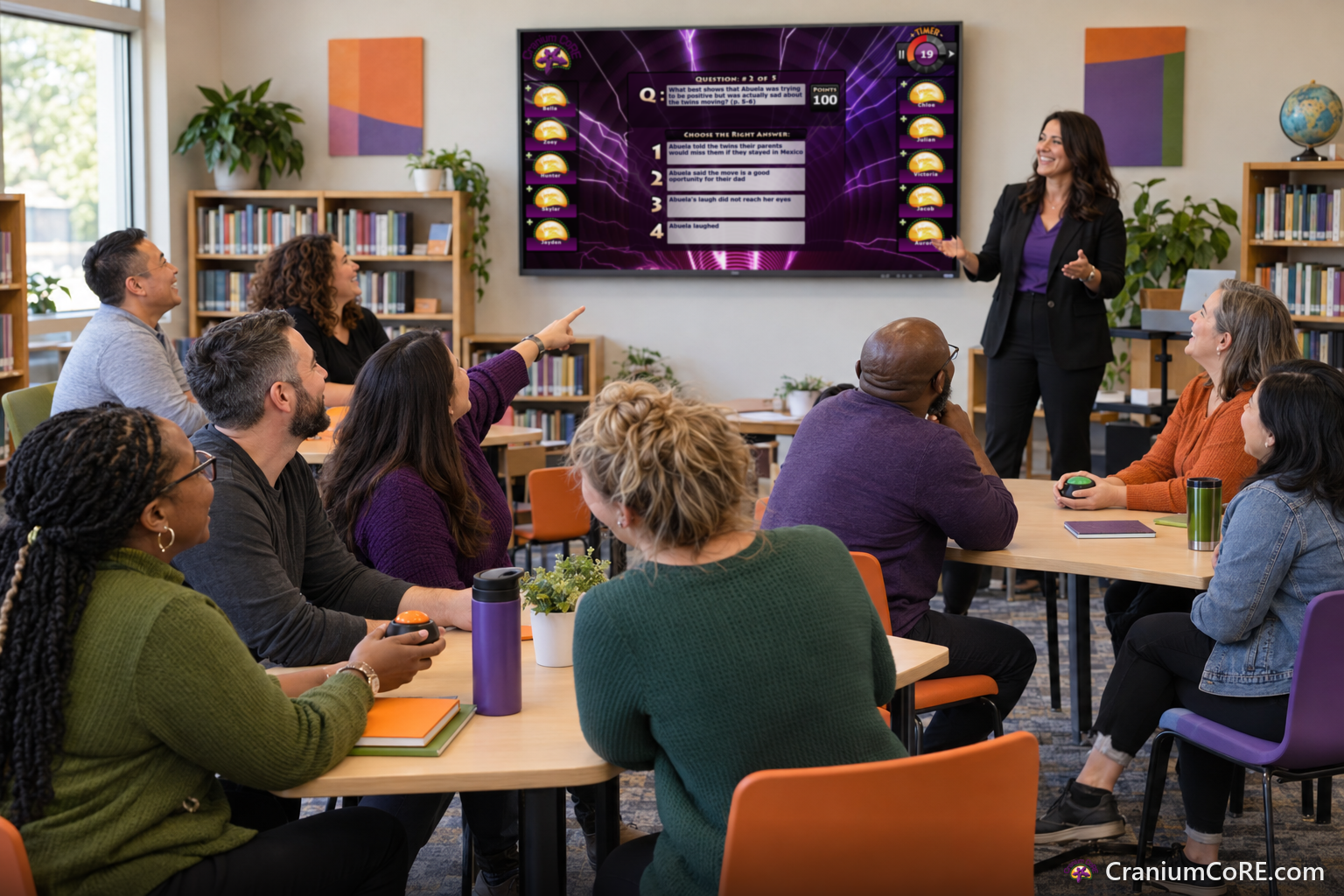
Teachers in teams play Cranium CoRE at a professional development session while the presenter hosts beside the screen.

Why a team reading game works

Put three students at one table, give them one device and one question they have to agree on, and something changes. Nobody can hide and nobody can coast. The quiet reader who found the line on page 42 is suddenly the most important person on the team. That is not a trick. It is cooperative learning, and it has one of the longest research records in education.

Roseth, Johnson and Johnson pooled 148 studies covering more than 17,000 early adolescents in 11 countries. Cooperative goal structures, where students can only succeed together, were linked to higher achievement and better peer relationships than competitive or individualistic ones. Cranium CoRE builds that structure in: one answer per team, so the team has to talk before anyone touches the device.

The talking is the second piece. Murphy and colleagues' meta-analysis of classroom discussion found that discussion approaches sharply increased how much students talk, cut how much teachers talk, and improved comprehension of the text. The approaches with the biggest effect kept the conversation anchored in what the text actually says, which is exactly what discuss and defend asks for. The Institute for Learning calls it Accountable Talk: talk that is accountable to the group, to accurate knowledge and to rigorous reasoning. When the host asks "show me where in the book," the room is doing all three at once.

What that looks like in a Cranium CoRE game

  • One device per team, so the first thing that happens after a question appears is a conversation, not a tap.
  • Three attempts per question with falling point values: being right matters more than being fast, so teams check the text before they commit.
  • Every team answers every question. A correct answer from one team does not end the round for the others.
  • The host pauses after a contested question for discuss and defend: a team reads the lines that prove its answer out loud, and the other teams listen for whether the evidence holds up.
  • Points for compliments at the end of the game ("put-ups"), given and received, so the competition stays friendly.
Game show, open book: why the format helps students remember and want to read

A Cranium CoRE question is a retrieval event. The team has to pull what it knows about the chapter out of memory, check it against the page, and commit. Cognitive psychologists call this the testing effect. Roediger and Karpicke showed that students who took a test on a passage remembered more of it a week later than students who simply re-read it, even with no feedback on the test. A game of twenty questions on a chapter is twenty retrieval events, and nobody in the room calls it a test.

Robert Marzano reached a similar conclusion from the classroom side. Across more than 60 teacher-conducted studies, using academic games was associated with an average 20 percentile point gain in student achievement, with the caveat that the gain depends on how the games are used. His four practices read like the Cranium CoRE house rules: keep the competition low-stakes, build the questions around essential content, debrief the game, and have students revise what they know. Discuss and defend is the debrief.

The motivation piece matters most for the reader who has never finished a book. Guthrie's Concept-Oriented Reading Instruction studies found that classrooms combining comprehension strategies with motivation supports (collaboration, choice, interesting texts) outperformed strategy-only classrooms on both comprehension and motivation, and a later analysis found that engagement was the mechanism carrying the gains. A team that needs you to have read chapter seven is a reason to read chapter seven.

Also worth knowing

  • A 2016 meta-analysis of digital games for learning (Clark, Tanner-Smith and Killingsworth, Review of Educational Research) found that game conditions produced moderately better learning outcomes than non-game conditions across 57 comparisons.
  • Marzano's companion piece on summarizing found that, across 17 teacher-conducted studies, summarizing strategies raised understanding by an average of 19 percentile points. A team defending an answer has to summarize the passage that proves it.

Cranium CoRE Research

Infographics

Charlotte Danielson's Infographic

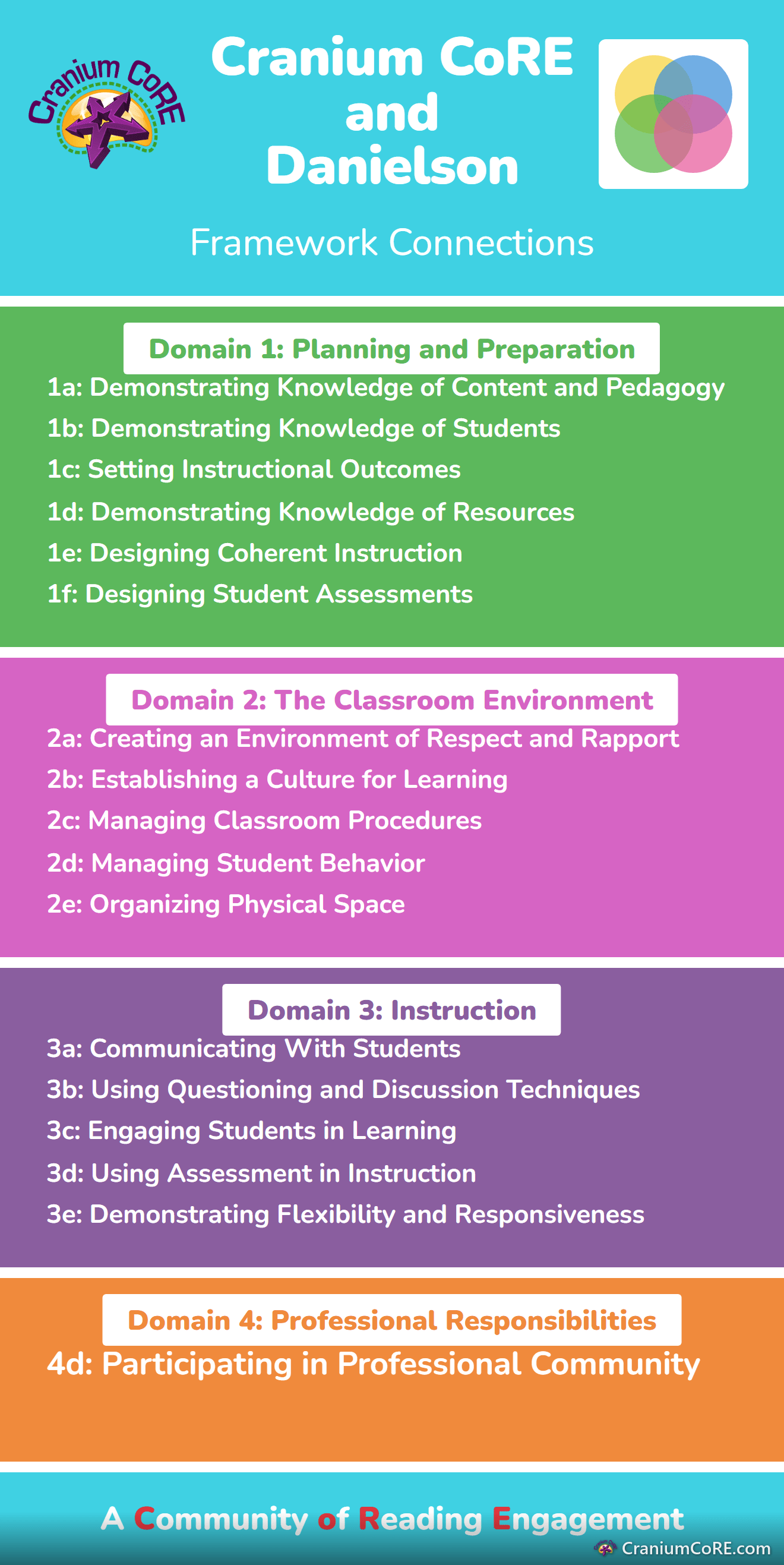
Cranium CoRE and Charlotte Danielson's Framework for Teaching: the domains and components a Cranium CoRE game connects toCharlotte Danielson's InfographicPDF

Robert Marzano's Infographic

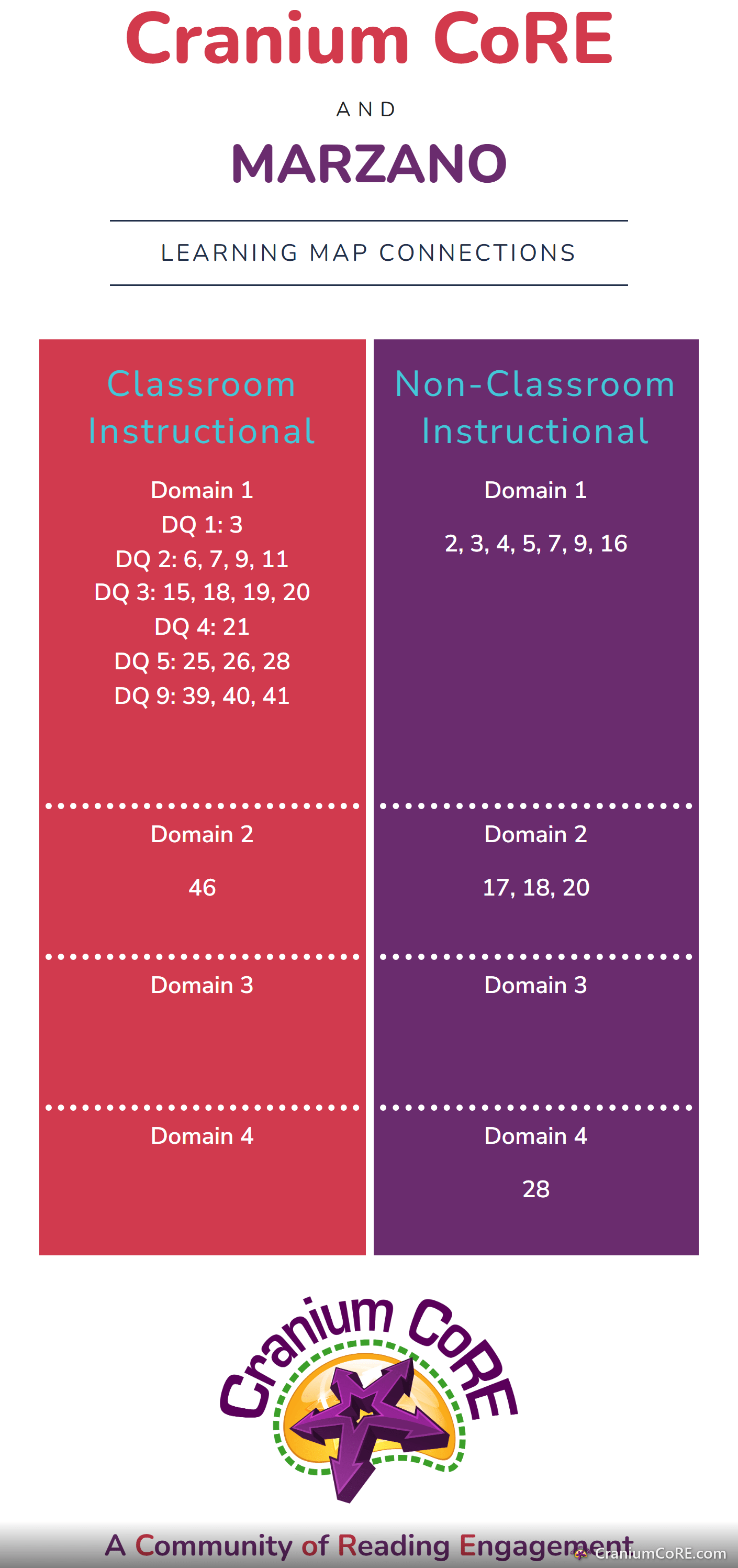
Cranium CoRE and Marzano learning map connections by domain and design questionRobert Marzano's InfographicPDF

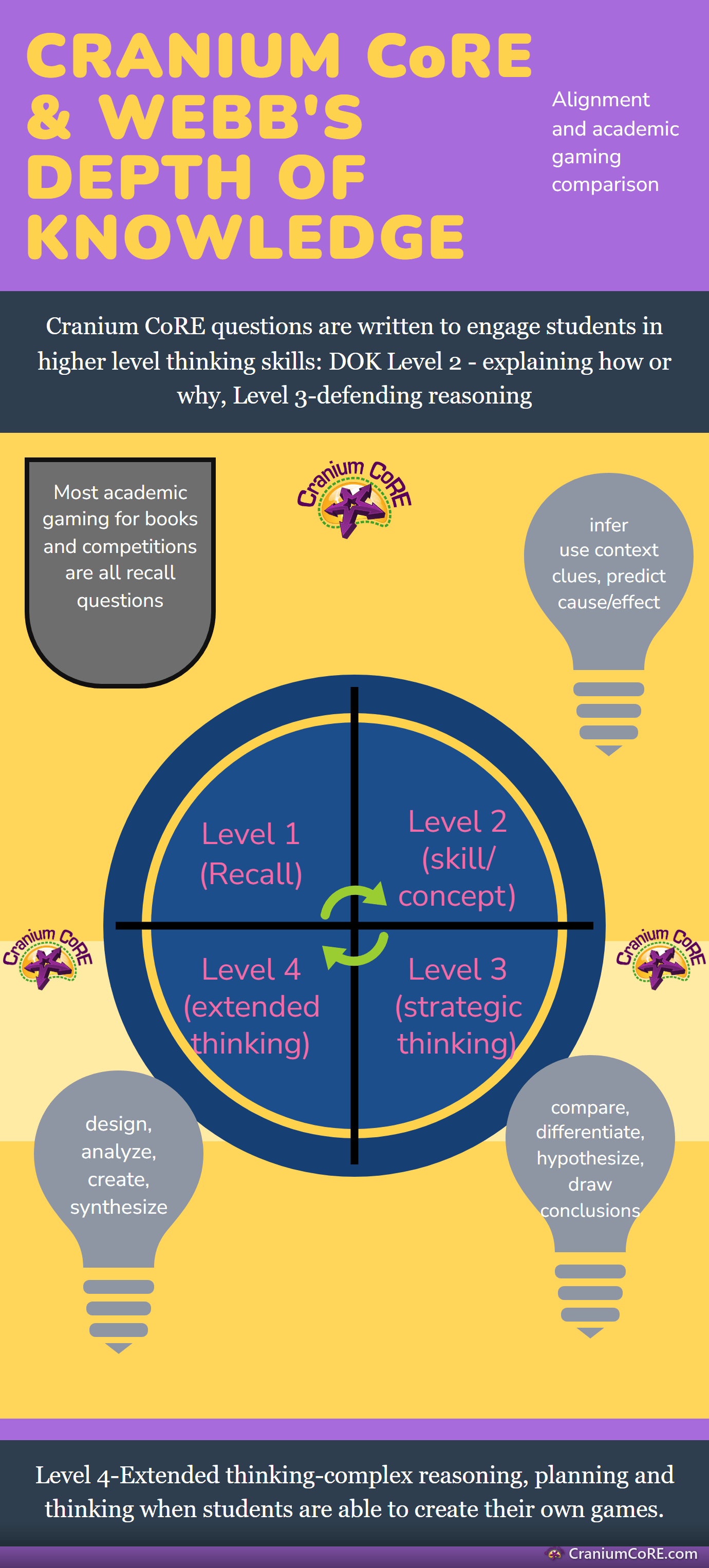
Webb's Depth of Knowledge Infographic

Cranium CoRE and Webb's Depth of Knowledge: questions written at levels 2 and 3, students creating games at level 4Webb's Depth of Knowledge InfographicPDF

Webb's Depth of Knowledge, level by level

Norman Webb developed Depth of Knowledge (DOK) in 1997 at the University of Wisconsin so that review panels could check whether a state test asked for the same depth of thinking as the standards it claimed to measure. It is not a ladder of verbs. It measures how deeply a student has to work with the content, so "describe" can be Level 1 or Level 3 depending on what is being described and what the student has to do with it.

The four levels

  • Level 1, Recall and Reproduction: retrieve a fact, a name, a detail. "What was the name of the farm?"
  • Level 2, Skills and Concepts: explain how or why, summarize, use context clues, predict, identify cause and effect. "Why does Templeton finally agree to help?"
  • Level 3, Strategic Thinking: reason with evidence, justify a choice, draw a conclusion the text supports. "Which passage best shows that Wilbur has changed since chapter one?"
  • Level 4, Extended Thinking: investigate, design or create across sources and over time.

Most book trivia lives at Level 1, and a buzzer round rewards whoever recalls fastest. Cranium CoRE questions are written at Level 2 and Level 3: explaining how or why, and defending reasoning. The discuss and defend step is a Level 3 move by definition, because a team has to argue from the text in front of the whole room. Level 4 arrives in the writing step. When a team writes its own game on a chapter, it has to decide what matters, draft questions with plausible wrong answers, find the evidence line for each, and test the game on classmates. That is extended thinking with a scoreboard.

Bloom's Taxonomy, revised: from remember to create

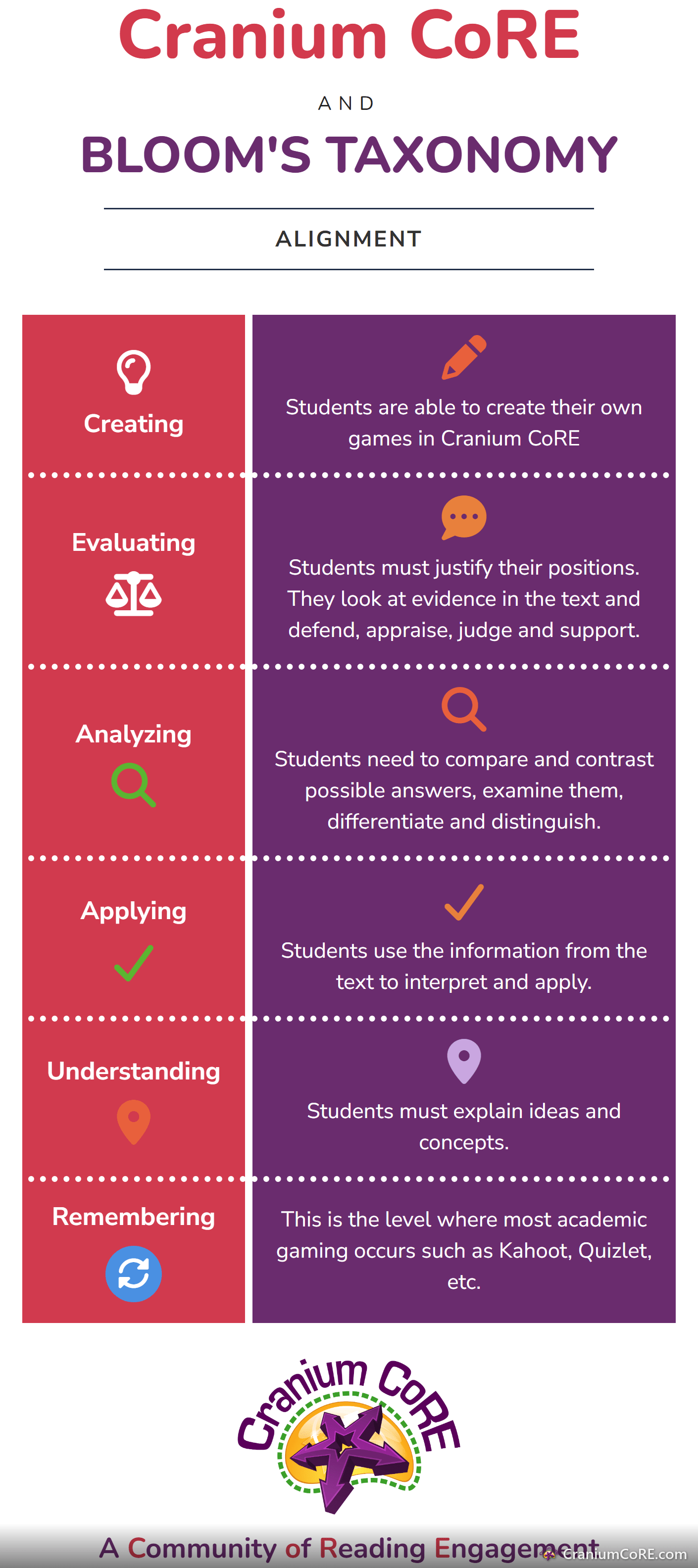
In 2001 Lorin Anderson and David Krathwohl revised Bloom's 1956 taxonomy. They turned the nouns into verbs, moved creating to the top, and added a second dimension for the kind of knowledge involved (factual, conceptual, procedural, metacognitive). The six cognitive processes, lowest to highest, are remember, understand, apply, analyze, evaluate and create.

Most academic gaming stops at remember: a term, a date, a character's name, first buzzer wins. A Cranium CoRE game starts one level up and keeps climbing.

Where each step of Cranium CoRE lands

  • Game play (understand, apply, analyze): the team explains what the question is really asking, applies what it read, and compares four plausible answers against the text before it commits one answer for the team.
  • Discuss and defend (evaluate): the team justifies its position out loud, judges the evidence other teams offer, and supports or revises its own.
  • Writing (create): students write their own questions and wrong answers on paper, choose the evidence line for each, and the teacher enters the best ones as a game for other classes to play.

One caution worth sharing with colleagues: Bloom's describes the type of thinking and DOK describes the depth of it. A "create" task can still be shallow if the method and the information are handed over. Writing a Cranium CoRE game is not shallow, because the students have to reread the chapter to find questions worth asking.

A team of students writes its own reading game questions on paper and index cards while the teacher helps.