
Research

Cranium CoRE and teaching frameworks

Cranium CoRE and the Marzano Art and Science of Teaching Framework, and Cranium CoRE and Charlotte Danielson's Framework for Teaching, with both infographics.

Robert Marzano

Cranium CoRE and the Marzano Art and Science of Teaching Framework

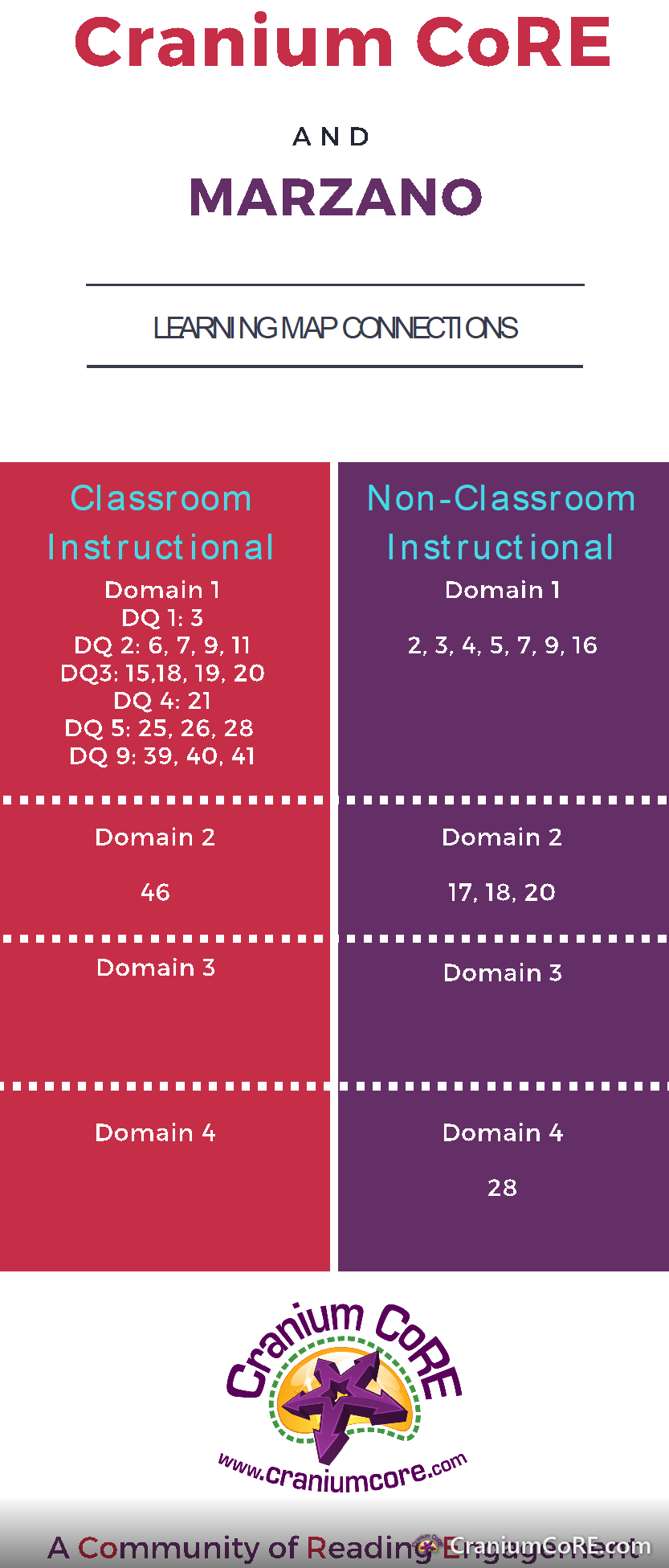
This document looks at all 41 elements of Domain I: Classroom Strategies and Behaviors to align them with Cranium CoRE methods and strategies. It has proven to be a practical, successful approach for teachers who are going to be evaluated based on Marzano's teacher evaluation rubric and are looking for ways to use technology and receive a great evaluation.

Robert Marzano and Cranium CoRE

In the last few weeks this past summer, three different large school districts have all indicated to us they follow Robert Marzano's lead on things from classroom strategies to evaluation criteria. Two of the three districts have seen Cranium CoRE in a classroom setting and mentioned that Cranium CoRE adheres very well to Marzano's teaching. The third district is too new to Cranium CoRE to make the connection yet, but, we feel confident they will see it also once exposed to it in a classroom.

One of these school district's administrators went as far as composing a document to make the connection between Marzano and Cranium CoRE to distribute to those interested in making a difference using cutting edge technology. That is what you will see here under the heading of "Talking Points."

The goal was to take two very involved, multi-layered sets of instruction for best practices within a classroom and connect the two in a simplified way where the two meet synergistically. Based on what we have heard so far, this document helps accomplish that goal. We hope it helps you. There are more connections than those listed, but, this is a good start, thanks to this administrator who saw the benefits of connecting the two.

What a Marzano-trained observer writes down while you host

Marzano's Art and Science of Teaching organizes classroom practice around design questions: how will I help students interact with new knowledge, practice and deepen it, generate and test hypotheses, and stay engaged? The Cranium CoRE guide on this page walks the elements of the original Domain 1. Since 2017 many districts have moved to the Focused Teacher Evaluation Model, which condenses the same practice into 23 elements across four domains: Standards-Based Planning, Standards-Based Instruction, Conditions for Learning and Professional Responsibilities. The evidence an observer looks for is the same, and a Cranium CoRE game produces it in a single class period.

Evidence an observer can write down

  • Identifying critical content: the question on the screen names the passage that matters, and the host's follow-up ("show me from the text why that was correct") names it again.
  • Helping students examine their reasoning: discuss and defend is nothing else. A team explains why it chose B, and the room examines whether the evidence supports it.
  • Helping students engage in cognitively complex tasks: hypothetical, compare-and-contrast and author's-purpose questions during play; students writing their own game afterward.
  • Organizing students to interact with content: teams of three to five, one device per team, so every student has to interact with teammates before the team can answer.
  • Using engagement strategies: a timer, a scoreboard, a game-show screen and animated discussion when a team finds the line.
  • Using formative assessment to track progress: the host sees which questions every team missed and can stop the clock to reteach on the spot.
  • Communicating high expectations for each student: every team answers every question, and the host asks why, not just what.

Observers rate what they see. A host standing among the teams rather than behind a desk, with every student looking at the screen and then into the book, gives them something to see.
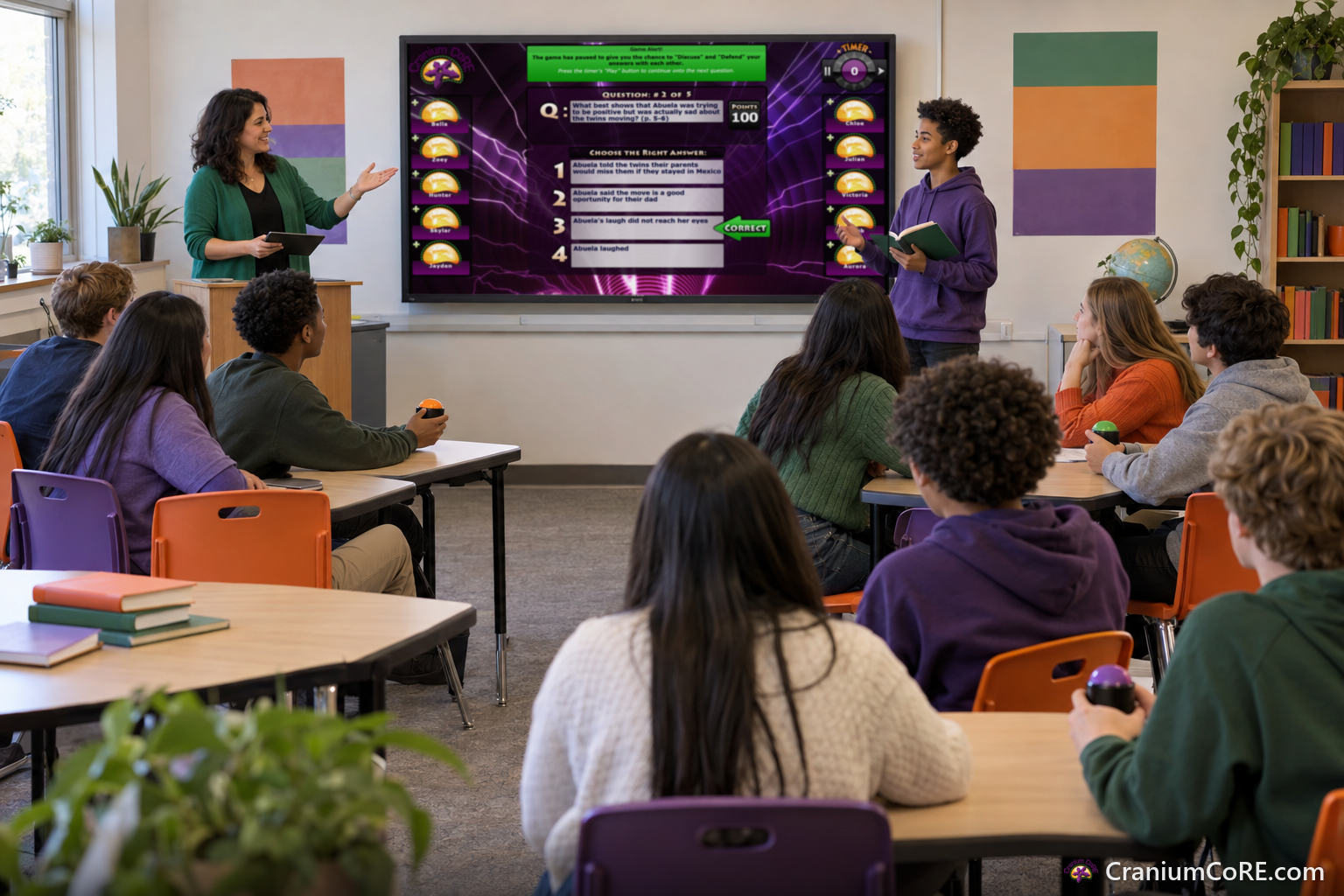
A student stands to explain his team's answer with the book in hand while the teacher hosts beside the Cranium CoRE screen.

Marzano's Infographic

Infographic of Cranium CoRE and Robert Marzano's classroom strategies

Charlotte Danielson

Charlotte Danielson's Infographic

Charlotte Danielson's InfographicPDF

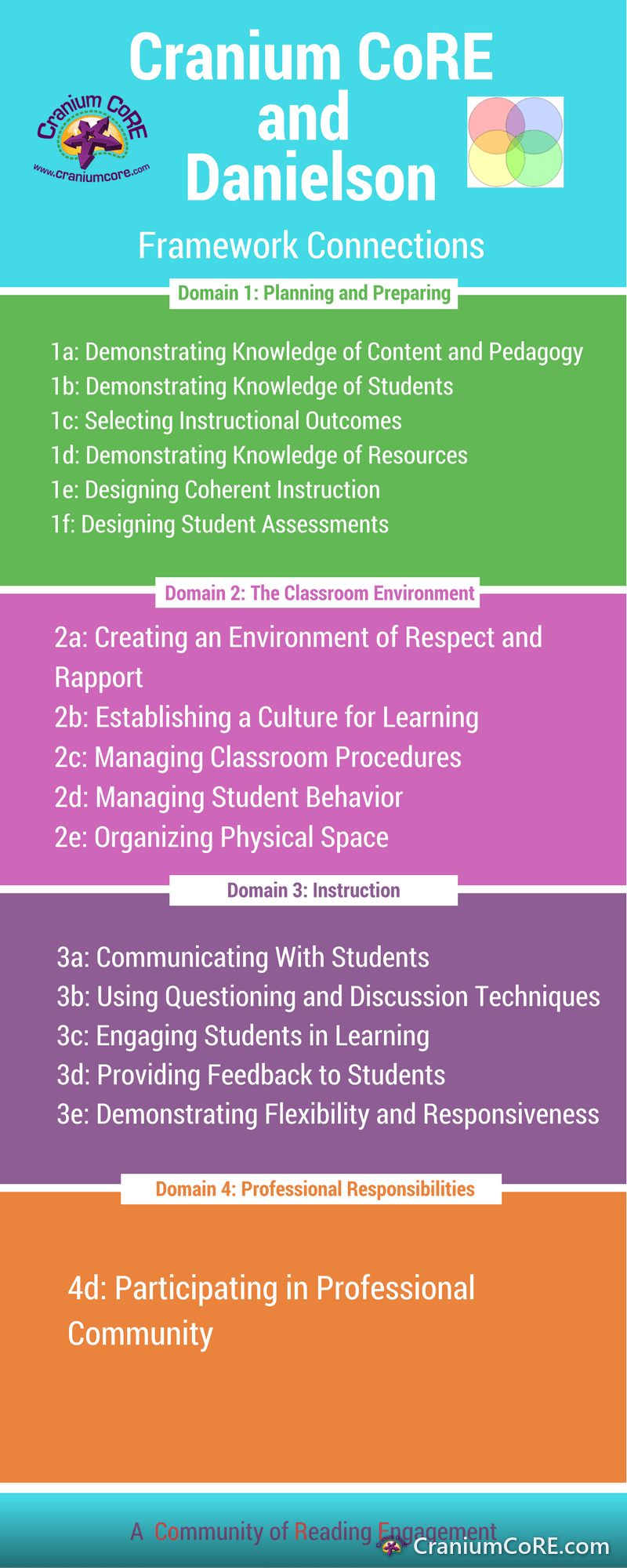
Cranium CoRE and Charlotte Danielson's Framework for Teaching

Download Cranium CoRE and Charlotte Danielson's Framework for TeachingPDF

Danielson Domain 3: questioning, discussion and engagement

Questioning and discussion are the only instructional strategies the Framework for Teaching names as components in their own right. Component 3b, Using Questioning and Discussion Techniques, and 3c, Engaging Students in Learning, are where many observed lessons are won or lost, and they are the two components a Cranium CoRE game is built to light up.

The 2022 edition of the framework renamed Domain 3 from "Instruction" to "Learning Experiences" and Domain 2 from "The Classroom Environment" to "Learning Environments." The component letters did not change, so the Cranium CoRE guide on this page, written against the earlier edition, maps straight across.

What the observer sees

  • Questions of high cognitive challenge, on the screen for everyone: inferential, hypothetical, compare-and-contrast, author's purpose, with four answers that all look plausible until you open the book.
  • Questions formulated by students as well as the teacher: the writing step, where teams write the next game.
  • The teacher steps out of the central role: during discuss and defend the host asks one question ("show me where") and the teams do the rest.
  • High participation: every team answers every question, every team member weighs in before the one device is touched, and the spokesperson role rotates.
  • Collaboration and teamwork as the structure, not an add-on: one device per team makes it impossible to play alone.
  • Instructional materials that are the actual books, open on the desks, used as evidence in real time.
  • Time for thinking and reflection: the host can stop the clock on any question and pause the game for discussion.

The short version: students are the ones working, and the teacher is the host, not the lecturer.
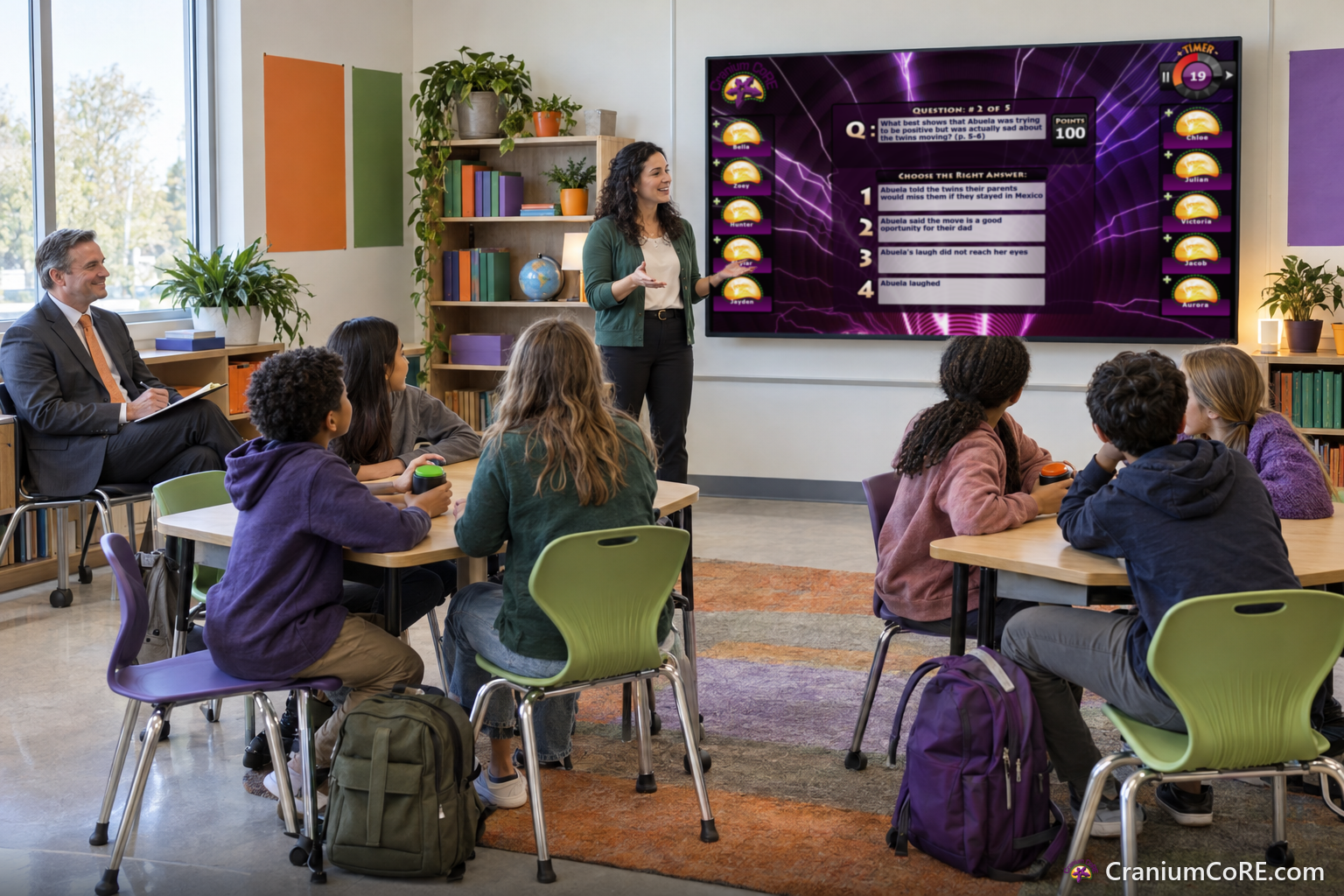
An administrator takes notes from the side of the room while a teacher hosts Cranium CoRE for teams of students.

Danielson Domain 2: the learning environment a game-show host builds

Domain 2 is about what the room feels like, and it is often the hardest thing to show in one observation. A Cranium CoRE game makes it visible in forty minutes.
Component by component

  • 2a, respect and rapport: teams give "put-ups" (compliments) to other teams at the end of the game, and both the giving and the receiving team earn points. Students hear their reasoning taken seriously by the host and by each other.
  • 2b, a culture for learning: the bar is set by the questions. They are textually complex and the book is open, so the expectation is not "remember" but "prove it."
  • 2c, procedures: the routine is read aloud, form teams, play, defend. One device per team means no device management for thirty students. Over time a student can take the host's place.
  • 2d, student behavior: engagement does the managing. Students behave to keep the privilege of a rigorous academic game.
  • 2e, physical space: the screen is the focal point, so every seat has to see it, and every team has to hear the others defend. A semicircle of team tables facing the screen does both.

Danielson's Infographic

Infographic of Cranium CoRE and Charlotte Danielson's Framework for Teaching