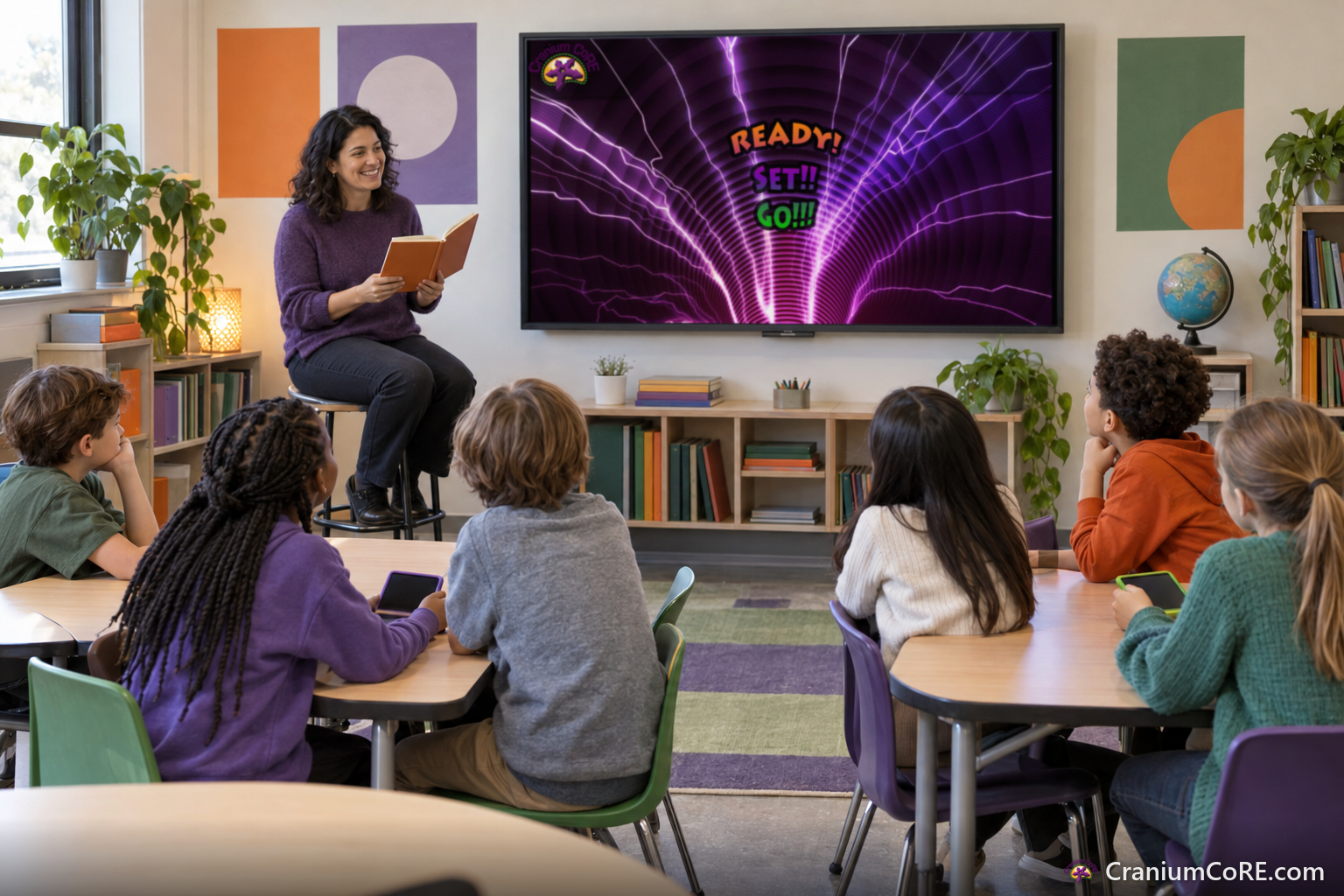
Reading along as a book is read aloud either by a teacher, a student or an audio device. The advantage of using an audio device is it will provide literacy modeling at its best due to the use of professional actors as narrators with multiple voices utilized.
Additionally, having the students eventually and occasionally read aloud will offer an excellent exercise in elocution for them.
2
Step 2 - Playing a TV style game show
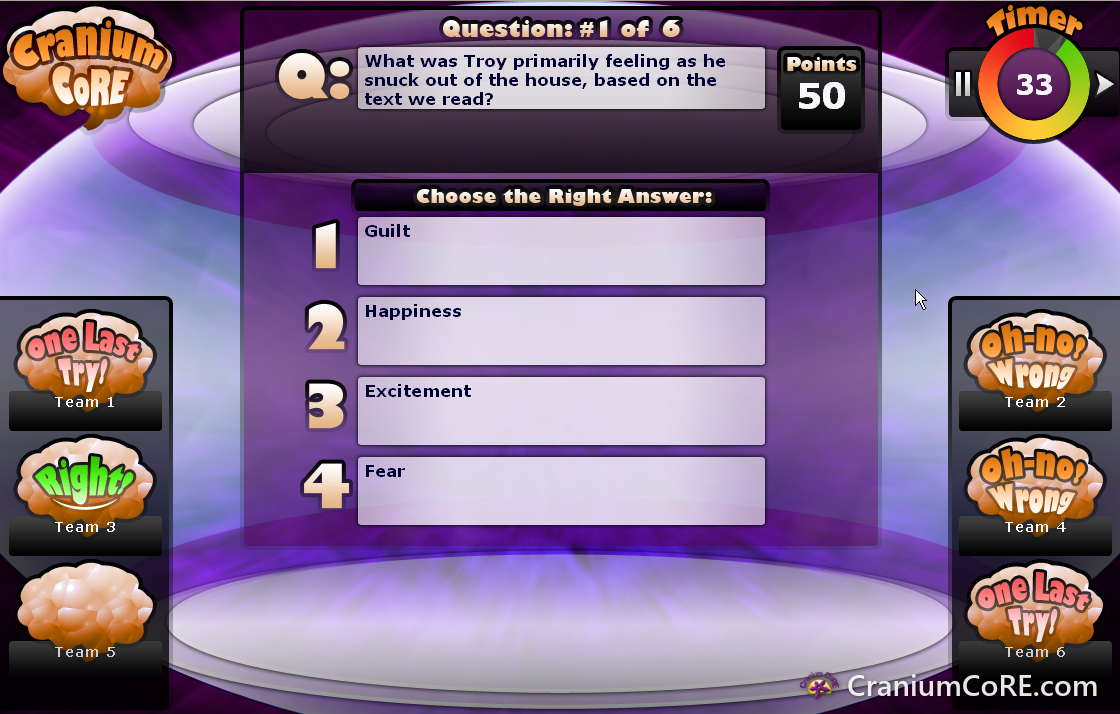
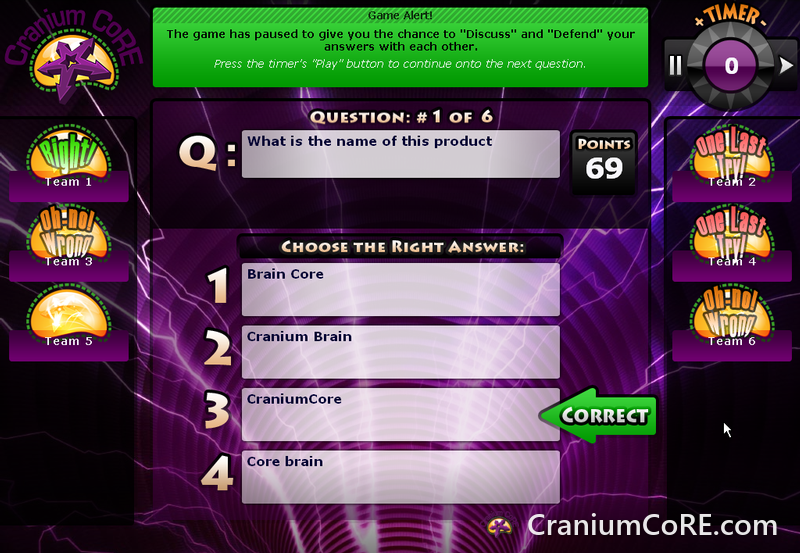
Playing a TV style game show in teams using mobile devices or radio frequency (RF) devices, one per team, to answer questions that appear on the game show image that is projected on a large screen so all the participants can easily see it.
The questions that are used for this part of the process are most often higher order thinking type questions that require more than just a literal response about what is remembered from the text.
This part of the process has the additional value of encouraging collaboration with team members through communication skill development and conflict resolution techniques.
The mobile devices and RF devices are a critical component because they provide a great vehicle for this team process to flow effortlessly and easily in a classroom setting.
3
Step 3 - Discussion to Defend
A meta-cognitive discussion to defend the answers and prove them contextually with an open book.
4
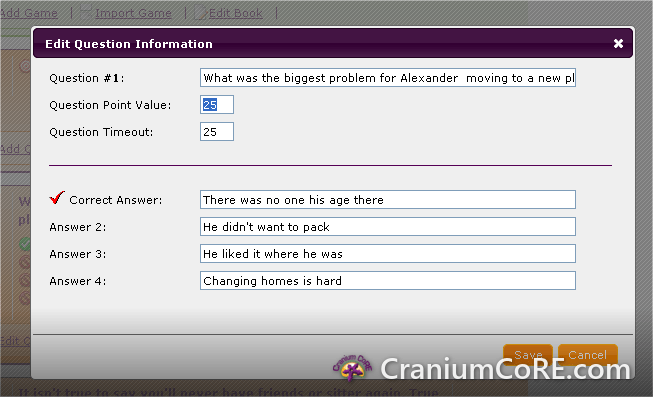
Step 4 - Compose own questions
Longer term it would be advisable to encourage members of the community to compose their own questions for Cranium CoRE games about literature, thereby increasing their ability to write. It has often been stated that if you know material well enough to write questions about it, you have demonstrated your mastery of the material.
The whole process is open book with the goal of practically exercising how to really understand the author's purpose for the composition being read.
This is a life long learning skill that will aid the members of the community no matter what curriculum or job they pursue.
Read Aloud, Read Along
Many years ago we were helping to market and develop strategies for an exciting, full motion video, interactive reading product similar to but different from Cranium CoRE, we had the occasion to meet with a gentleman named Jim Trelease. He is a well known author and speaker about reading in general. His most well known book, "The Read Aloud Handbook" had a tremendous impact as Andy's son, Drew, was in the womb. Andy read to Drew each day before he was born and after. To this day, Drew, is very good with language skills, due in no small part to Jim Trelease's influence on him.
It was logical to seek out Jim Trelease when we were wrestling with a few ideas about this new product. Andy will never forget the day in 1997 when he was in his living room discussing reading and Jim forever changed the direction they were heading.
The premise that had been made with this new product was that a student would read a book cover to cover in order to play an exciting TV style game show with higher-level thinking questions. Jim Trelease liked the concept a lot, however, he had some good thoughts to add.
He reasoned it was too unrealistic to expect a child to read a whole book to play the game, especially a child who was not a good reader and consequently did not like to read. He thought it would be much better to play a game after reading a section of the book, like a chapter at a time. His recommendation was to read aloud a chapter of a book to a class, have them read along or just listen and then play the game.
This technique had another benefit. Since we know that a child can listen to text being read and comprehend about two years beyond their reading level, this reading along method evened the playing field a bit for the individuals within the classes. Reading along also helps when the time comes to go to the text to find your answer or defend it afterward.
As you are by now aware, this Cranium CoRE method is an open book format. The goal is to drive the students into the text to find their answers and prove them. Since many of the questions are high up on Bloom's Taxonomy, this technique of reading along is very helpful to those who need some assistance with this process. Like anything else in life, this skill improves with practice. The more you do it, the better you get. Cranium CoRE provides a fun filled track on which to practice.
Game Play
This is typically the favorite part of this process and is the hinge between reading aloud/along and discussion. It is the game play that really engages the students and has stimulated those who have never read a book from cover to cover to do just that.
Our online community design uses specially adapted radio frequency (RF) transmitters that do not require any software on the computer. Since we do not emphasize Cranium CoRE as an individual assessment tool, we have kept away from using these RF transmitters as individual devices utilized per student. Our system uses a maximum of ten Side Keys transmitters with four (4) keys used per transmitter. No conversion software is needed to convert hundreds of keystrokes into unique signals. It is a much more elegant design and technologically much easier to plug and play wherever you have Internet access.
Side Keys RF transmitters are available to Premium members; most schools today play with the free Cranium CoRE Remote app on their own devices.
Teamwork is the key to this model being a much better method to develop stronger social skills like communicating well and conflict resolution in a competitive arena. Sounds true to life, does it not?
You will observe improvement in these social skills rather quickly because of the practice and the positive peer pressure exerted. Not only do students read ahead to ensure they don't let their teammates down, they also become very adept at working more smoothly together. It is commonly known among experienced Cranium CoRE members that it isn't always the team that knows the most that scores the highest. It is often the team that works together the best that scores the most. This is an important life long learning skill witnessed every day in sports but not as often in the classroom.
Discuss and Defend
Conversation leads to better comprehension. This age old adage is at the heart of what makes Cranium CoRE so successful and so different. We live in an insane day of never ending testing and assessment while we all chase the holy grail of test score improvement in order to obtain more funding dollars from the government. Unfortunately as a result, our students are not, typically today, given enough time to read aloud to each other much less have thematic discussions about what they read or how they think when defending a position they have taken related to the text.
This Cranium CoRE process of meta-cognition springs naturally and easily from the highly engaging activity of interacting with other players on your team while you compete against other teams in an academic, TV style game show. One of the challenges we all face as educators is how to lure the students in our charge into this higher order thinking world as we compete with really enticing things that take them away from the same. Anyone alive and over fifty years of age today can look back and clearly see the effect television has had on our society, both good and bad. It is no stretch to connect the advent of videos, video or computer games, game-boys. etc. to the mental lethargy we now witness in our students. More specifically, our students have a difficult time converting text into images. Their ability to imagine has been compromised.
It is time for change, don't you think? Education should be FUN. It shouldn't be easy though. Cranium CoRE takes these two, seemingly at odds, concepts and mixes them in an elegantly simple recipe for life long success. When given a chance, our students really like to read and talk about what they think and feel after reading part or all of a good book, fiction or non-fiction. Cranium CoRE enticingly moves even the most disengaged students across a threshold into what for many of them is a whole new world of thinking about how they think (meta-cognition).
Granted, Cranium CoRE can be effective at increasing comprehension if you just let the students play the game and compete as teammates against other teams. The well-written H.O.T. (higher order thinking) questions are that good. If you stop there, however, and do not engage these students in a discussion to defend their answers, you are missing a huge opportunity to take them to another stratospheric level of thinking.
Let the games begin!!
Writing
If any educator thinks it is a challenge to entice a student to willingly and joyfully read, they most likely understand it is commonly even more of a challenge to have them willingly and joyfully write. Agreed?
Of all the great enticements Cranium CoRE brings to the table of education, this part of the process holds the greatest potential, for the teachers and the students alike. Just ask any reluctant writer, say a teenage boy, if they like video games or TV game shows. The answer, not surprisingly, is usually "Yes." Then ask them what interests them. That might be a difficult question to answer for some students. If it is a boy, it might be framed about sports they like, as an example of a direction to head. The bottom line is this: Everyone has something of interest in their lives. Finding it is often the key to a more successful educational approach to their heart with reading, writing, speaking and listening.
Please stay with the logic flow here and you should see the pot of gold at the end of this rainbow. Now, once you find the interest, ask this same student if they would like to produce a TV style video game for their friends to play to test them on the topic. The answer to this is most often a skeptical, "Sure, but, how would I do that?"
Enter Cranium CoRE. This game show production capability within Cranium CoRE is so elegantly easy it invites even the most reluctant writer to give it a try. The thrill associated with having other people play a game you made is so alluring that it is difficult to deny. Think about some student across the country playing your game and how that would feel? That is what this virtual community is all about.
Typically, students who have experienced the game playing within Cranium CoRE will actively and willingly attempt to compose questions for even a piece of literature as a beginning effort at Cranium CoRE game production. This effort, as with the game playing itself, can be a good platform for collaboration. A teacher could assign sections of a book for each team to compose questions and then play their games to see whose questions were the best.
For the sake of those who would like to know the process we have used to create the questions we have composed over the years, there is a tutorial built into our Cranium CoRE subscription member's website.
Let your mind wander and you will see the limitless nature of where this could quickly take even our most reluctant students.
FAQ
Need help understanding Cranium CoRE? Our frequently asked questions section can help. Watch this short video clip at the bottom of this page and/or read the FAQ's below to get answers to your most wanted questions.
Why are there some books in Cranium CoRE with just a chapter or two with games?
One reason is that we may have been to a location that wanted to see how Cranium CoRE works and had been given a segment of a book to cover on a particular day with a class. Another reason is that we sometimes do a 1st and/or 2nd chapter of a book to give a school a jump start so they can add more questions as they can get to it for other chapters. The goal has always been and still is for the community to contribute to the content over time.
When a team answers the question correctly does it stop the game play?
No. All teams have a set number of seconds and three attempts to answer correctly.
Can the game be paused?
Yes, the game can be paused by the game show host/teacher when appropriate.
Is the same number of points for the correct answer given no matter how many attempts are used to answer correctly?
No. The point value goes down with attempts.
Does the team that answers first get more points?
No. The issue is not speed, but correctness.
Can this be used as an assessment tool?
Yes, observationally. The goal of this methodology is to promote thematic discussion of the text resulting in greater comprehension.
How often are titles added to Cranium CoRE?
Our community of teachers and librarians adds new games daily, and the founder, Andy Larson, authors them monthly. With "community" involvement the pace will increase dramatically. Any members' games will be published immediately.
What makes this better than other reading comprehension strategies?
To start with there are multiple strategies at work within Cranium CoRE. The two most obvious are discussion and the high level of engagement due to educational gaming.
How do your questions develop critical thinking skills?
There are multiple types of questions beyond literal types of questions such as: hypothetical, inferential, persuasive argument, compare/contrast, author's purpose and sequencing.
Why is team play recommended?
It's as elegantly simple as real life, the collaborative effort that fosters inter-dependent thinking, i.e. conflict resolution.
Will there be assistance to learn how to write higher level thinking questions?
Yes. There will be a template with examples provided.
Community
An online community is built on information sharing, interoperability and user-centered design. The modern web led to the development and evolution of web-based communities, hosted services, and web applications.
As with other online communities, Cranium CoRE allows users to do more than just retrieve information. Members can share and collaborate online, allowing users to run our software application entirely through a modern web browser and interacting using an iOS or Android device. Members participating in our community of thinkers drives the collaboration and joy of use.
Cranium CoRE uses an "Architecture of participation" that encourages members to add value to our application as they use it. This stands in contrast to traditional websites, the sort that limited visitors to viewing and whose content only the site's owner could modify. Our site offers a rich, user-friendly interface with real-time updates that works in any modern browser.