Read these testimonials from people who have used our process. At the bottom there are Video Testimonials from some of our members. Visit our YouTube Channel and upload your own video testimonials - post them as video responses.
"For most children reading is hard and writing is even harder. This TV game show format within the Cranium CoRE methods offers an exciting environment that motivates children of any age to read so they can participate in this fun filled event. I highly endorse it as a way to encourage children to read and write."
"Andy Larson is one of the most creative individuals anyone could find. On top of that, he has never totally grown up. This makes his ideas for attracting children to reading arrive with an adult's perspective, but the heart and soul of someone under 18. His Cranium CoRE vision launches a reading initiative that can attract children with all levels of reading capability. He uses a very familiar format, a quiz show, allowing them to fit the questions to their experience. Andy has been on the cutting edge of motivation for many years. This is going to be a superb reading motivation program."
Teacher Satisfaction
This may seem completely unimportant to some who read this and I can tell you it was not the primary reason for coming up with the method and strategies you will experience on our website. Additionally, we, as teachers, most likely all started out idealistically thinking the job satisfaction would be pretty high as we worked to develop the young minds with which we would interact in this profession.
Well, to my great surprise, even I, who typically do not know a single student when I have flown into a city to demonstrate these methods with a classroom full of students, always walk away feeling really good about myself for the effort. My experience with this covers 30 years, hundreds of class hours, every possible grade level from 3rd to 12th grade, almost every state in the union and every socio-economic stratum known. It has always worked to fully engage the students and pull them into thematic, metacognitive discussion. I can only imagine what it would be like if I had the opportunity to have spent time with these same students and know about their varied backgrounds, interests, strengths and weaknesses.
When I see shining eyes I know the method is working. There is nothing better than to see a group of students who the world has pretty much given up on become so engaged that they will completely read a book for the first time in order to play the game and hold their own in answering challenging questions.
Consider what Deb Svec from Palm Beach Gardens High School in Florida has to say about the incredible feeling she gets when the students clap when she enters the room.
"They aren't clapping for me, but, for the game experience they look so forward to having again and again. I am probably the most well known teacher on my campus with the student body. It feels wonderful to see how these students improve with these Cranium CoRE thinking skills over time and how the other teachers in my school are catching on to this great way to engage even the hardest to reach students. When they succeed, I know I have succeeded. On top of that, it is just plain fun."
Improved Test Scores
This topic generates more interest and heated discussion than all the other topics put together. That shouldn't surprise anyone really. Test scores drive the educational bus and have been driving it for a long time, especially since the advent of the No Child Left Behind legislation. For almost any idea, program, method, you name it these days, the question becomes, "Will it increase test scores?"
For many, this becomes a left-brain versus right-brain analysis. Our way is primarily a right-brain, creative type of thinking. We often say, "I just know what I know" in answer to proving the benefits of Cranium CoRE on test scores. To us it is a "no brainer" when it comes to the evidence.
It is all about research-based evidence that has been around for decades. The process includes: reading aloud/reading along, higher order thinking questions (Bloom's Taxonomy), discussion (conversation leads to better comprehension) and defending your position (meta-cognition). It is all wrapped up in a highly engaging, hi-tech educational gaming format (online community). All of these individual pieces have loads of research to prove their effectiveness.
Enter the left-brain dominant thinkers who are highly analytical and need data to support everything they do. They want data on the specifics, so, please don't confuse them with research that requires an inferential leap of faith. And don't expect them to watch the process and try to see if it fits the educational puzzle of methods and strategies that work well to meet objectives for life long learning.
Current K-12 education is dominated by testing and also time spent preparing students for these tests. It has a stranglehold on our educational system's creativity that is often times unhealthy and counterproductive.
Cranium CoRE is a welcome alternative that is very effective at test preparation yet so well-disguised it would never be viewed that way by the students. Just listen to some of the video clips to hear what teachers know to be the truth about this topic. Then try it out and see what you think.
Collaboration
Experiencing Cranium CoRE has many benefits in addition to the four language arts skills (reading, writing, speaking, listening) that are engagingly practiced within. One of the primary additional skill sets that a student practices using Cranium CoRE is teamwork.
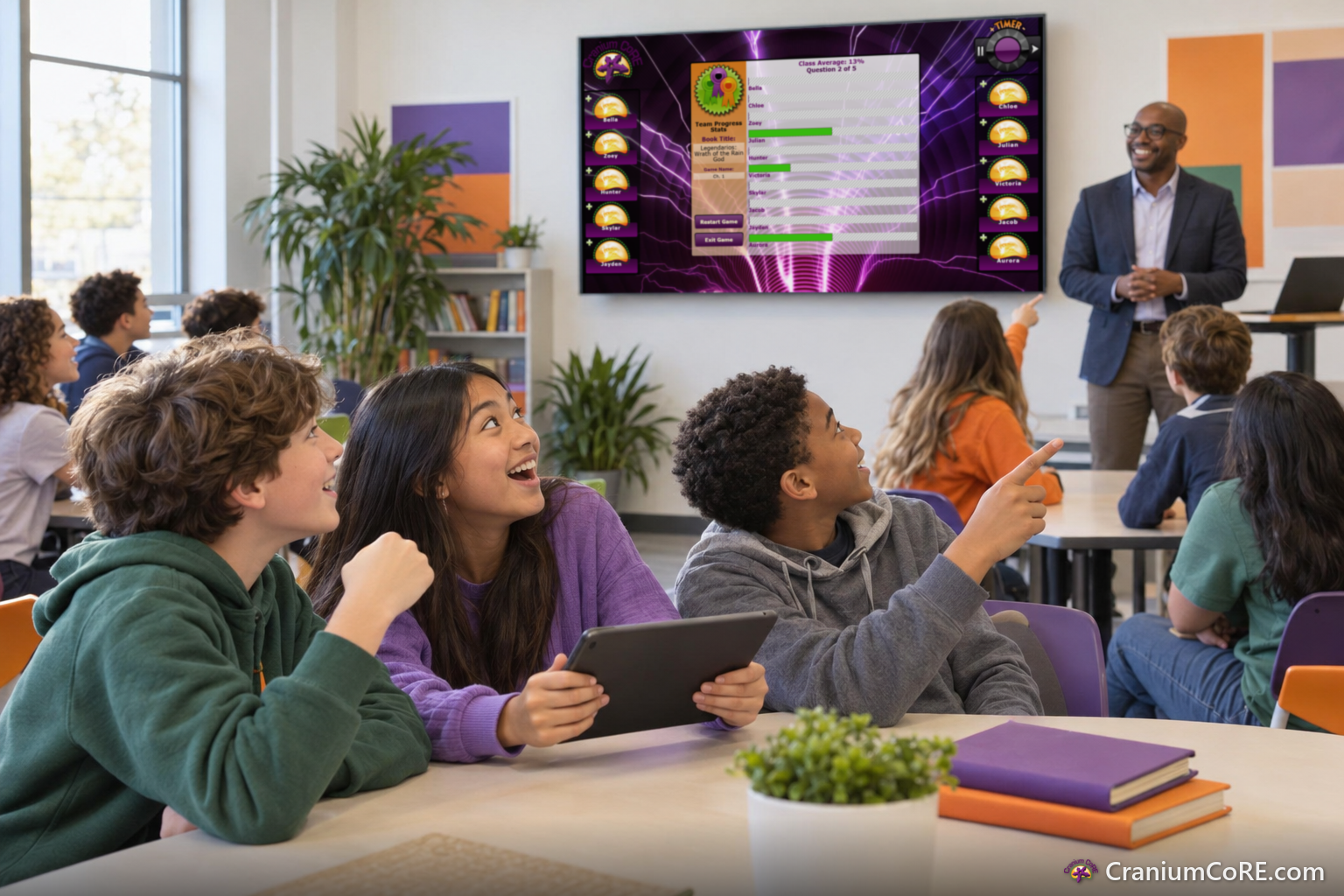
The format, using the Side Keys, is perfect for teams to be established within the classroom. The ideal number of players on each team for Cranium CoRE is three. Three players can talk quietly and relatively quickly compared to five or seven players on a team. The use of odd numbers works well to avoid a tie when dealing with differences of opinion about which answer is best supported by the text. This is one of the reasons we have a set of ten transmitters in our standard Side Keys package. It means that even if you had 30 students in a class, you would still have enough transmitters for three players on each of the ten teams.
The more the students work together to answer questions in a team format, the better they become at communication, problem solving and conflict resolution. There are not many occasions today in schools where the classroom mirrors a real life scenario in the working world. Playing Cranium CoRE provides this and much more.
The collaboration extends to the teachers as well. Cranium CoRE can be an excellent vehicle for interdisciplinary work using literature, both fiction and non-fiction, as a source for instructional material. You could extend the collaborative effort to the school district as a whole and have schools compete against one another or work together to either play or compose games. Two schools in the same grade can play one game: the host school runs the game-show screen and shares it on a video call; the other school's team watches the shared screen and answers on its own device.
High school speech and debate classes could work with feeder schools all the way down to the elementary level to build a high school specific minor league for speech and debate. Individual high school students or pairs of students could go out periodically to the feeder schools, read aloud to certain classes and play Cranium CoRE with books for which they have composed questions.
This dual purpose effort would include demonstrating an exercise in elocution, reading aloud, as well as demonstrating how to quickly find the supporting evidence in the text to defend an answer.
This is just the beginning of what will be a grand journey for the collaborative benefit of all involved.
Life Long Learning
This is a summary statement for all the parts of the Cranium CoRE processes making up the method and strategies within.
This CoRE, Community of Reading Engagement, is aimed at preparing all the members of the community at being better at thinking and making decisions based on what they read. Information is doubling every 15 months or so currently. It is becoming correspondingly difficult to keep up with it. Therefore, the ability to find valid information quickly is an increasingly valuable skill. Cranium CoRE has the goal of improving this skill in the crosshairs.
If you read, write, speak and listen well, you can take those skills to any curriculum, any job and greatly enhance your chance at success. It is this simple concept that drives us at Thinkersize, LLC.
The frosting on this cake comes with the social interaction skills embedded in the game show experience we recommend; independent thinking with interdependent decision making and discussion.
When you experience Cranium CoRE, you hopefully will see the multiple layers of skill sets exercised. The virtual community we are building should empower the members to attain greater success in whatever direction they choose to go in life. There will be, no doubt, unintended and unforeseen benefits as we chart our course together in this Community of Reading Engagement. Please join in and enjoy the ride!
Response to Intervention (RtI)
You could write an entire book about how Cranium CoRE, with its multiple strategies that work well for literacy skill development, can fit well with RtI.
There are many specific issues that must be addressed in order to effectively implement RtI approaches. Strong leadership and effective collaboration are essential ingredients in implementing RtI. Cranium CoRE is all about collaboration at several levels; teacher to teacher, teacher to student, student to student, teacher to parent, parent to student. As time goes on and our Cranium Community of Reading Engagement grows, there will be an endless stream of examples cited on this website of RtI success stories.
In addition to the leadership and collaboration issues, schools must be prepared to offer a variety of proven instructional strategies, staff must be trained to measure student performance using methods that are sensitive to small increments of growth and parents must be kept informed of these new procedures and made partners in the process. Cranium CoRE is not an assessment tool and was never designed to be. There are more than enough assessment vehicles available to educators for this facet of RtI. The strength of Cranium CoRE is in the potential strategies for the incremental educational growth as well as involvement with the parents.
Perhaps the most commonly cited benefit of an RtI approach is that it eliminates a "wait to fail" situation because students get help promptly within the general education setting. Cranium CoRE can be a very alluring, dynamic educational piece of this RtI puzzle.
Universal Screening is a step taken by school personnel early in the school year to determine which students are "at risk" for not meeting grade level standards or those who have behavioral or emotional problems that may interfere with their learning. Once the target audience has been identified with Universal Screening, either for an individual or a group, Cranium CoRE has incredible appeal to attract and hold the attention of even the most disengaged students.
You will see two video clips below. In one, you can listen to how Cranium CoRE and RTI has helped a Florida media specialist in her RtI role at her school. In the other video clip, you will hear how the "at risk" students this same librarian mentors feel about the Cranium CoRE process. The second video was podcast as part of the Florida Association of Media in Education (FAME) Media Quarterly Newsletter.
Video Testimonials:
If you have access to YouTube you can post your own via our YouTube Channel
Students TestimonialsMore Students TestimonialsStudent & Teachers TestimonialTeacher TestimonialsTeachers Testimonial 2Teacher Testimonial #3Student Game ContributionFAME (Florida Association for Media in Education) features Cranium CoRE in its Florida Media Quarterly.What is Cranium CoRE?